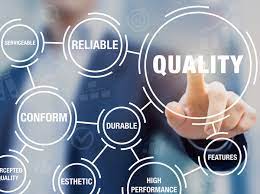
Information has traditionally been viewed as a by-product of a computer system or procedure. This viewpoint intents that there should be a focus on designing and delivering computer systems, with little focus on the information gathered. A need for trustworthy, valuable information grew under customers, and the focus was shifted to information as the main product, being produced by a computer system. We can thus refer to information quality as how trustworthy, valuable, well structured, and correct information produced from these computer systems are (Springer, 2019).
Importance of information quality:
As data management techniques and technologies improve, data becomes more and more valuable to businesses, having major impacts on important decisions the business must make in everyday business. Data becomes more and more beneficial the higher quality the data is, with low quality data risking wrong decisions that can even harm the business. We can thus deduce that good data quality can lead to the needed knowledge to make good, impactful business decisions, while knowing all the complications the decisions might lead to. (Lotame, 2019-2023).
Benefits of good information quality (Lotame, 2019-2023).
Information gathered and processed can be both good and bad quality, and both can equally impact the final decision a business makes equally. That is why it is important businesses have good information quality, to make the best decisions. Let's look at some benefits of having good information quality
Improved data quality leads to better decision-making across an organization. The more high-quality data you have, the more confidence you can have in your decisions. Good data decreases risk and can result in consistent improvements in results.
Better audience targeting
Without high-quality data, marketers are forced to try to apply to a broad audience, which is not efficient. When you have high-quality data, you can more accurately determine who your target audience should be. ou can use this knowledge to target advertising campaigns and develop products or content that appeal to the right people more accurately.
Improved relationships with customers
High-quality data can also help you improve your relationships with customers, which is crucial for success in any industry. Gathering data about your customers helps you get to know them better. You can use information about your customers’ preferences, interests and needs to provide them with content that appeals to them and even anticipates their needs.
Easier implementation of data
High-quality data is also much easier to use than poor-quality data. Having quality data at your fingertips increases your company’s efficiency as well. If your information is not complete or consistent, you must spend significant amounts of time fixing that data to make it usable.
Competitive Advantage
If you have better quality data than your competitors or use your data more effectively than they do, you gain a competitive advantage. Data is one of the most valuable resources that today’s companies have, as long as it’s high quality. Better data quality means that you can discover opportunities before your competitors do.
The most important thing when it comes to good data quality, is being able to distinguish it from bad quality data. Let's look at some good data quality characteristics (Sarfin, 2022).
Characteristic
How it's measured
Accuracy
Is the information correct in every detail?
Completeness
How complete is the information?
Reliability
Does the information contradict other trusted sources?
Relevance
How needed is this information in completing the main task at hand?
Timeliness
How up to date is the information? For what amount of time will this information be seen as accurate?
References
Springer, 2019. Information Quality: Managing Information as a Product. In: M. T. Ö. Ling Liu, ed. Encyclopedia of Database Systems. New York: Springer New York, p. 1502–1508.